
I’m a fan of dystopian fiction, but I’m a bit finicky about it. I tend to stay away from Young Adult dystopian (no Hunger Games or Divergent series, thank you). I usually like more literary-minded picks, but there are exceptions. I’ve been reading Octavia Butler, so I started thinking about my favorite dystopian novels. Here they are, in no particular order:

The Stand, by Stephen King (1978).
How it all ends: Accidental release of deadly bio-weapon
Basic premise/plot: A superflu kills 99% of the population; the survivors must choose between the powers of good and evil for the fate of humankind, following either Mother Abigail (good) or Randall Flagg (evil).
My thoughts: One of my first Stephen King reads, and one of my favorites. It’s a huge book with a ton of characters, but gripping for the most part. It’s been years since I’ve read it, but there are memorable characters I’ll never forget: Trashcan Man, in particular, who likes to set garbage (or anything, really) on fire–and even sets a whole empty city on fire; Tom Cullen, the mentally-challenged guy who is always spelling moon (“M-O-O-N, that spells moon.”) King is always entertaining.
Adaptations: I’ve seen the 1994 miniseries with Gary Sinise as Stu Redman and Molly Ringwald as Frannie. I liked it, for the most part. I haven’t watched the 2020 version, but maybe I’ll put it on my list.
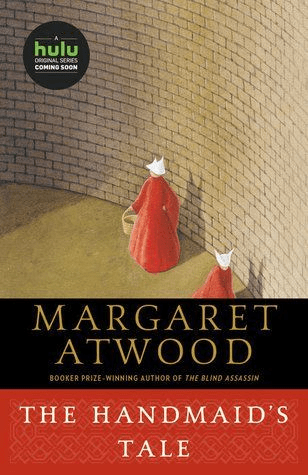
The Handmaid’s Tale, by Margaret Atwood (1985).
How it all ends: Subjugation of women through theocracy take-over.
Basic premise/plot: In the near future, America has been taken over by a theocracy and renamed The Republic of Gilead; in a world of dwindling birthrates, women of child-bearing age have become property with no rights and used by wealthy couples to have children.
My thoughts: I read this book years ago, and it outraged me. Not the book itself, which is brilliant, but what happens in the book. I was young and couldn’t imagine such a thing coming to pass, couldn’t imagine women’s rights being so eradicated and reduced to basically medieval status. Ah, the naivete of youth. Now, it not only outrages me, but scares the hell out of me. Because it absolutely could happen, as far-fetched as it sounds. I won’t get into politics here, but let’s just say I’m not too optimistic about women’s rights just about now.
Adaptations: There was a 1990 film that I never saw (and I heard it wasn’t very good), but I’ve watched the first season of the series on Hulu in 2017. It’s fairly true to the book with a few smart changes, and was sobering and upsetting to watch. In fact, I decided not to watch the following seasons because I just couldn’t bear it, lol. I’m someone who can get through every brutal season of Game of Thrones, but this show just hit a nerve for me and I couldn’t continue.
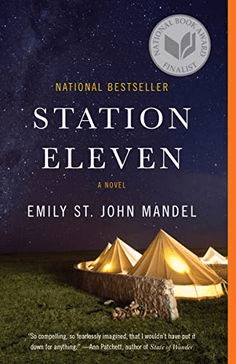
Station Eleven, by Emily St. John Mandel (2014).
How it all ends: Worldwide Deadly Pandemic
Basic premise/plot: A worldwide pandemic has nearly destroyed the human population; a group of actors and musicians travel the countryside in the Great Lakes region to entertain the survivors with Shakespeare and classical music, as they believe “Survival isn’t enough.”
My Thoughts: I adored this book. I mean, it’s tragic that the flu happened, but the story and the writing is wonderful. If you’re looking for a Mad Max kind of post-apocalyptic world here, you won’t find it–it’s too quiet. There’s just not enough people. But those who are left behind find a way to survive, and this particular group–actors and musicians–try to bring a little joy back into life through art. It makes you think about what makes life worth living, beyond survival. It’s about art and memory and what lasts. There’s a bit of danger from a religious zealot (of course), but it’s the connections between past and present that’s really interesting to me.
Adaptations: HBO Max has a miniseries adaptation, but I haven’t seen it. It sounds like a lot of changes have been made, and I love the book so much, I don’t want to experience that.
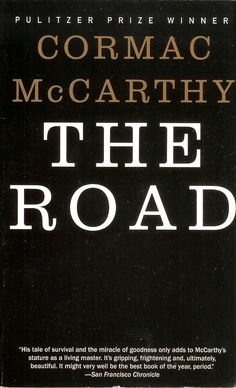
The Road, by Cormac McCarthy (2006).
How it all ends: Unknown; landscape destruction and societal breakdown.
Basic premise/plot: An unidentified disaster has reduced civilization to rubble and anarchy. A man and his ten year old son travel the dangerous landscape, heading south along the east coast for warmer weather and hope.
My Thoughts: This is a very difficult book to read. I’m not talking about the language; it’s simple and clear. But the subject matter is so damn heavy. There’s been some vague disaster (I think it’s clever that we, the readers, don’t know what it is, because it puts us in the characters’ shoes–they don’t know, either.) It doesn’t really matter what happened, only that it destroyed life as we know it. A nameless man and his ten year old son traverse an ash-covered wasteland, heading south along the Atlantic coast in search of warmer weather. They must find food and shelter along the way, and avoid those who would steal from them or kill them. Cannibalism is a very real thing (there’s a few scenes concerning this that traumatized me, lol). The man is determined to keep his son alive and safe, though he knows he himself his dying. His son, a sweet, good boy despite the horrors he’s seen, “carries the fire,” which I interpret as the light of civilization, the hope for humankind. It’s a very dark read, but does offer some hope.
Adaptations: There’s a 2009 movie with Viggo Mortensen as the Man and Kodi Smit-McPhee as the Boy. I thought it was a great adaptation, and not just because I love Viggo.
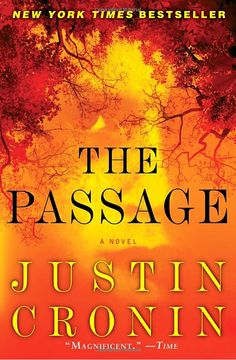
The Passage/The Twelve/City of Mirrors, by Justin Cronin (2010-2016).
How it all ends: Accidental release of scientific experiment that turns humans into vampire-like creatures.
Basic premise/plot: A scientific experiment intending to make humans stronger goes awry; it instead turns the test subjects into vampire-like creatures who escape and either kill or transform the rest of the human population into more of them. The key to saving humankind resides in a little girl named Amy.
My Thoughts: I was totally mesmerized by this trilogy of books. It was recommended to me by my sister, who had read the first book, and I instantly fell into it. My sister ended up not reading the next two books, lol, but I tore into them eagerly. It alternates between past and present, from just before the experiment destroys the population, to a hundred years into the future with people trying to deal with the aftermath. Each book gets closer to the origin of the experiment and how it all went wrong, and how those in the future will begin a new era.
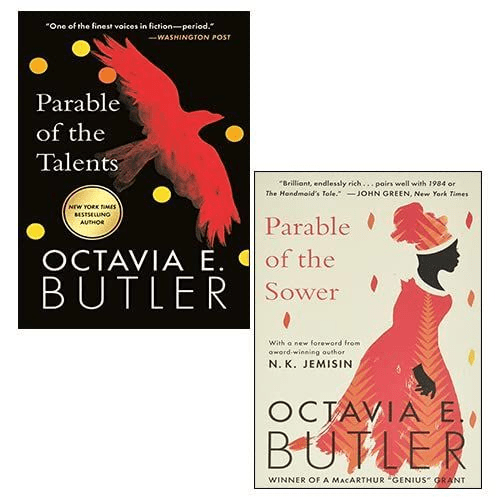
Parable of the Sower/Parable of the Talents, by Octavia E. Butler (1994, 1998).
How it all ends: Societal breakdown and anarchy; theocracy take-over.
Basic premise/plot: In the 2020’s, society has broken down into violence, illiteracy, drug addiction, and corporate slavery. Precocious 15-year-old Lauren Olamina sees the direction her world is going in. After her walled neighborhood is attacked and destroyed, she heads north from LA to northern California with a group of survivors, traversing the dangerous roads, determined to survive and start a new way of living.
In Talents, Olamina and her people have been living in their new community, Acorn, for five years, and it’s beginning to grow and thrive; she and her husband have a baby, Larkin. But disaster strikes–the community is raided by Jarrett’s Crusaders, an extremist group from Christian America; the men and women are enslaved and the children abducted. They live in abject slavery and horror for seventeen months. When they’re finally free, Olamina must decide how to rebuild her life, and Earthseed. Her husband was killed and her two month old baby taken, while her passion about Earthseed is stronger than ever.
My Thoughts: I really wish Butler had been able to write her intended third book in this series, because I did not want to say goodbye to these characters and this story. Talents ended in 2090, with Earthseed flourishing and fulfilling their Destiny, but Olamina and her daughter, finally reunited years after the disaster, have a strained relationship. The ending was fairly rushed, and I think Butler intended to write more about Olamina’s final years, and her struggles with establishing Earthseed and her relationship with both her daughter and her brother, in the third book, which she was going to call Parable of the Trickster. But alas, we will never know that story. These books will stay with me for a long while.
Adaptations: I’ve heard that an adaptation is in the works; A24 has bought the rights and slated to be directed by Garret Bradley, but no other details as of yet.
I’m sure I’ve overlooked other dystopian books that I’ve read over the years, but these are the ones that come to mind and I loved the most.
What are your favorite dystopian stories? Let me know in the comments and we’ll talk about it!





 Star Wars and Other Obsessions