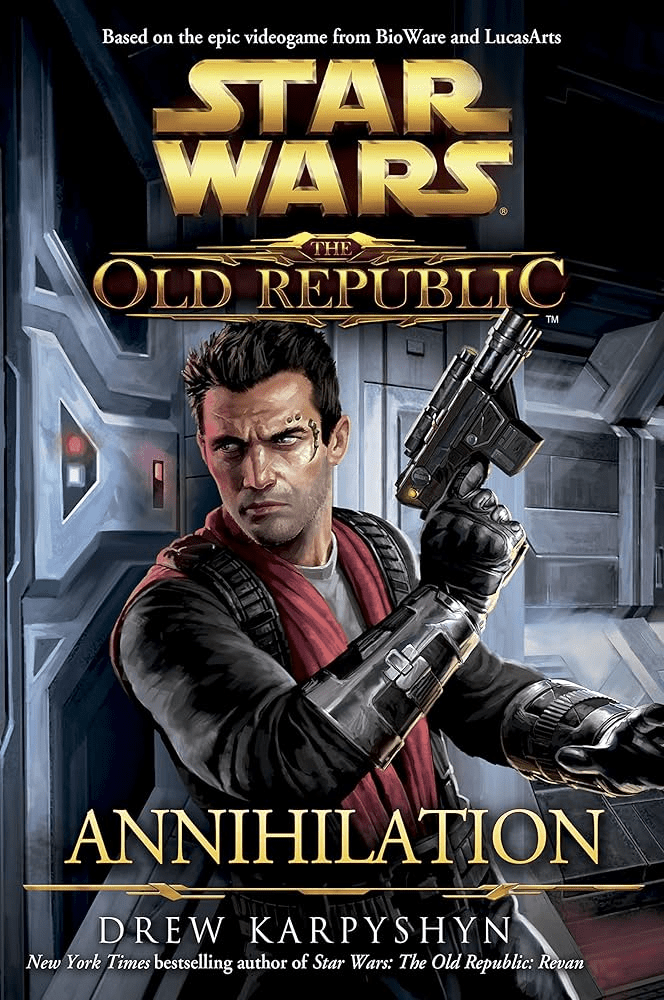
Hello friends, and welcome to the latest installment of my Legends Reading Challenge. We’re still in the Old Republic (and will be for a bit), and this time it’s Drew Karpyshyn’s Annihilation. Let’s get into it!
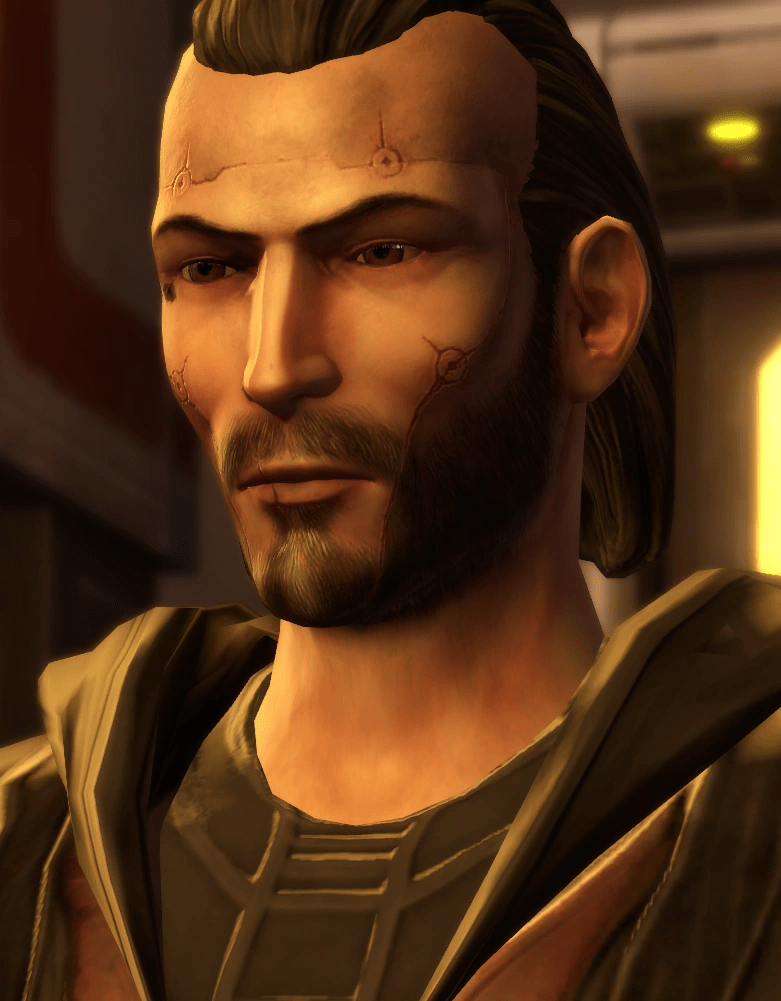
This one stars Theron Shan, the son of Grand Master Jedi Satele Shan (descendant of Revan and Bastila Shan). Except Satele gave him up at birth, to be raised by her former master, Ngani Zho. Satele, besides breaking the Jedi code of no attachments, knew that having a child would distract her from her job as a Jedi fighting for the Republic against the Sith Empire. Theron knew who his mother was, and understood why she gave him up, but they never had contact with each other or had a relationship of any kind. He never knew his father, and Ngani Zho was all the father he ever needed. Turns out, though, Theron didn’t have an affinity for the Force, so instead of going to the Temple, he trained as a spy for the Republic. And he’s very good at his job.
The Sith Empire seems to be flagging in the war with the Republic, but a ship called the Ascendant Spear is a huge threat. It belongs to the Sith Lord Darth Karrid, who can plug into the ship itself through portals surgically implanted into her brain, making it extremely dangerous to the Republic cause. The Supreme Commander of the Republic Forces, Jace Malcom, wants this ship destroyed and decides to send Theron, along with Jedi Master Gnost-Dural, on a mission to destroy it. Gnost-Dural was Darth Karrid’s master before she fell to the dark side. They come up with a plan, but not before Jace has a stunning realization: Theron is most likely his son. He and Satele had had a relationship decades ago during the war, and Satele never told him she was pregnant. And Theron doesn’t know, either. Before the mission, Jace tells Theron he’s probably his father, and Theron isn’t exactly thrilled with the revelation. Ngani Zho was his father, the only father he ever knew or needed. Jace’s revelation is unsettling, to say the least.
Anyway, Theron and Gnost-Dural must execute a rather complicated plan: they need to steal a black cipher from the Empire’s Minister of Logistics, which will allow them to listen in on Imperial transmissions to find out where the Ascendant Spear will be docked; but they can’t know it was stolen, or they’ll change the encryption codes and it will be worthless. So they have to break into the Minister’s Office, steal the cipher, replace it with a broken one they have, and then blow up the building so everything will be so damaged they won’t know the cipher was replaced by a damaged one. Got that?
Of course things don’t go exactly according to plan, but they manage to get the job done with only a few injuries. They go back to Coruscant, and through the cipher find out the Spear will be docked at Reaver Station. They need a way onto the station to get to the ship, which they intend to sneak on board and plant a virus that will incapacitate it. They enlist the help of Teff’ith, a young Twilek woman that Theron sees as a kind of younger sister and feels responsible for (they had some adventures together in a video game–I think? Or comics?–and Ngani Zho died protecting her). She does not appreciate Theron’s help and really wants nothing to do with him, however. But she’s part of the Tion Brotherhood, a criminal gang that can get them ship codes, uniforms, and a way onto Reaver Station, so they make a deal.
After some trouble, they get on board and Gnost-Dural goes to face his former Padawan. His plan is to get her to send the Spear to the planet Duro, which is going to be attacked by the Empire. Theron had sent Teff’ith to Coruscant to ask his mother, Satele, for help–if she can convince Jace to send a Republic fleet, they can save Duro and take down the Spear at the same time. Gnost-Dural fights Darth Karrid’s two apprentices and then her for a time, but gets captured. But it’s all part of his plan, even the torture he endures at her hands.
Meanwhile, Theron finds a way on board and gets to the engine room, where he connects to the ship’s systems through his cybernetic implants (I forgot to mention those, lol) to try to find a way to plant the virus. But then he figures out he can’t plant a virus, as Karrid connected to the ship would know instantly and destroy it. So he decides that when (if) they get to Duro, he’ll just sabotage several systems like weapons, communications, etc, on the fly to give the Fleet a chance to destroy it. If they get to Duro.
Gnost-Dural has gone through some horrendous torture, but manages to manipulate Karrid into going to Duro. Once there, the battle ensues, and Theron causes some trouble for Karrid once she’s plugged in. He also releases Gnost-Dural from his prison, and the Jedi makes his way to Karrid’s chamber. Theron leaves the engine room and they meet up; Gnost-Dural fights Karrid’s apprentices while Theron tries to get into Karrid’s sealed chamber. By this time, the Fleet has dealt fatal blows to the Spear and the ship is failing; the apprentices flee to escape pods and Karrid is blown up inside her chamber. Theron and the Jedi find an escape pod and get out of there, to be picked up by Jace–along with Satele and Teff’ith–on his Republic ship.
We leave with Theron softening a bit on Jace, and maybe–eventually–Satele.
I enjoyed this book–I liked the characters, there was a good balance of action and character development, and the pacing was good, moving right along its 350 or so pages. I really thought I’d have to slog through these Old Republic novels, but so far they’ve been pretty good. I give “Annihilation”:
3.5 lightsabers out of 5.
Up next is “Knight Errant,” by John Jackson Miller. I tend to like his Star Wars novels, so I’m looking forward to it. (According to my list, “Lost Tribes of the Sith” is the next book, but I’m not feeling it right now, lol. I think I’ll save this one for last in the Old Republic category.)
Hello friends! It’s been a while since I posted about my Legends Reading Challenge, but I’ve finally finished The Old Republic: Fatal Alliance, by Sean Williams. On top of it being quite a hefty read (482 pages!), I put it down a few times when I was busy reading current canon like The Last Order and Mask of Evil. It didn’t help that the story wasn’t (at least initially) very compelling to me. But let’s get into it.
SPOILERS!!! (Legends have been out for years, but just be aware.)
The story takes place about ten years after the sack of Coruscant by the Sith, as related in the book Deceived. There’s a treaty, but also a very cold Cold War between the Republic and the Sith Empire. It starts with a strange ship being intercepted by a smuggler called Jet Nebula (not his real name, as you can imagine). He’s on a job for the Hutts, but decides to see what kind of cargo this ship has as a bonus. But before he can board the Cinzia, it self-destructs. He takes what’s left of it back to the Hutts, who decide to auction off what they have. Tasha Bareesh, the ruling Hutt, doesn’t reveal what it is, but lets it be known that it could be very profitable and change the balance of power in the galaxy.
Into this mix comes several characters: Shigar Konshi, a Kiffu Jedi Padawan who is sent to Hutta to investigate what it may be (his master is Grand Master Satele Shan); Eldon Ax, the apprentice to Darth Chratis, with instructions to steal whatever it is; Ula Vii, a Republic envoy who is actually an Imperial spy, sent by the Republic to find out what it is and who hopes to use it to please his Imperial masters; Larin Moxla, a disgraced Republic soldier (who is also Kiffu like Shigar) who meets and accompanies the Jedi Padawan; and Dao Stryver, a Mandalorian whose interest and motive in acquiring the item is a mystery to all. All they are told is that it’s from an unknown planet that could hold untold riches in minerals and/or have a strategic advantage. Naturally, both the Republic and the Empire want those things.
They all have competing interests and loyalties, they all end up on Hutta, and naturally chaos erupts and battles are fought. As they all fight each other, whatever it is the Hutts have escape the vault it’s locked in. Turns out they are droids, but unlike any droids they’ve ever seen. They dub them “hexes” because of their shape, but they are super-resiliant, adaptable, and lethal. They can join together to increase their strength. And they endlessly scream “We do not recognizeyour authority!”
Turns out the killer droids were made by Lema Xandret, a particularly skilled droidmaker, who hates the Sith Empire with a rage she put into these droids. The Sith had taken her young Force-sensitive daughter, named Cinzia, and that loss and rage fuels her to create droids that could wipe out the entire galaxy, if attacked. Here’s the twist: the Sith apprentice, Eldon Ax, is that child who had once been Cinzia. She doesn’t remember her mother, Lema Xandret, and only wants to finish her mission for Darth Chratis (who she hates, by the way).
The Essential Legends edition of Fatal Alliance, with Eldon Ax and Shigar Konshi on the cover.
Anyway, the droids in the vault are finally destroyed, but Ax leaves with a piece of the “nest” from which the droids can replicate themselves, and Stryver has the ship’s navicomputer, both of which lead them back to the planet they originated from. Shigar has psychometric abilities and a piece of a droid, from which, after some persuasion from his master, he’s able to discern the coordinates. Or close enough. Envoy Vii ends up with Shigar, Larin, and Jet Nebula.
They all converge on the planet Sebaddon, which is near a black hole just outside of the galaxy itself. They all reluctantly agree to work together to destroy the colony of hexes (Lema Xandret and the small colony are already dead) to save the galaxy. They hatch a plan to have mixed troops attack two spots on the planet: the equator, where the CI (central intelligence governing the hexes) seems to be, led by Satele Shan and Eldon Ax; and the southern pole, where the actually factory building the hexes is located, led by Darth Chratis and Shigar, as well as Larin and some troops.
While on the ground, which is a very unstable, volcanic landscape, Darth Chratis tries to seduce Shigar to the dark side (doesn’t seem like a good time to do that, but whatever, lol). The Sith Lord and the Padawan fight, and Shigar has to fight the dark side, the anger, within himself.
On the equator, Satele and Ax come upon the actual central intelligence of the whole operation: a clone of Lema Xandret’s daughter, Cinzia. She’s younger by a few years, and suspended in a red, bacta-like substance, where she’s lived her whole life. The red fluid has some kind of metal in it that blocks her Force abilities. Lema had put her here to protect her, but she’s been a virtual prisoner. The droids had killed Lema Xandret when she sent the ship out to make a deal with the Mandalorians, as they were programmed to fiercely protect Cinzia. But her mother somehow lives on in the fluid, talking to her daughter in a kind of telepathy. The hexes take orders from Cinzia now, but she’s been so isolated and protected, she’s quite naive and doesn’t know anything about the outside galaxy, or the battles that have been taking place above the planet. She wants to know Ax better, her “sister,” what her life’s been like. Ax is appalled, naturally, and doesn’t really want anything to do with her. Her mother, “alive” through the liquid, starts to strangle Cinzia when she doesn’t listen to her and decides to help them with the hexes. Satele breaks the glass of the tank to save her, but she’s not used to living outside the tank, and dies shortly thereafter. But Cinzia told Ax she could control the hexes, like her, if she uploaded her DNA into the matrix, which she does.
After that, the battles end and Ax announces to Darth Chratis she no longer answers to him. He scoffs, of course, but then she orders the hexes to attack and kill him, and then to destroy themselves.
Afterward, Ax goes back to Dromund Kass and becomes an apprentice to Darth Howl, who is on the Dark Council. I was kind of hoping she’d leave the Sith Order, but no, she has her own ambitions and Darth Howl is the pathway to that.
Shigar is now allowed to take the Jedi Trials, which he’d been denied at the beginning of the book. I liked him throughout the story, but he does seem a bit angry and rash. I think he’s meant to join other Jedi later on who want to engage the Sith in battle sooner rather than later, if only to end the cold war and get on with it. Another war is coming.
As an aside, I just want to say that yes, Lema Xandret was a little insane, lol. Okay, a lot insane. But as a mother, I totally understand her maternal rage. If the devil stole my child to raise as evil, I’d burn down the galaxy in revenge, too. Just putting that out there.
So, all in all, I thought the book was fine. It took me a while to warm to it and get to know the characters, and actually care about what happens to them. They all had their own personal battles to fight, which tends to draw me in more than space battles, lol. But by the last quarter of the book, I was eager to see how it all worked out. I do believe this book is linked to the Old Republic video games, so there’s probably some stuff about these people or events I don’t know or understand. But that’s okay. In the end, I give this book:
Three out of Five Lightsabers.
Next up is The Old Republic: Annhilation, by Drew Karpyshyn.
Hello friends, the Legends Reading Challenge continues with book #4, Red Harvest, by Joe Scheiber.
(Warning: SPOILERS!!!)
So, this one is that rare combination of Star Wars and horror, specifically: zombies! Not my usual cup of tea, although I will admit to having watched the first few seasons of The Walking Dead, as well as The Last of Us (which I loved). So zombies aren’t completely off the table for me, lol.
This one takes place about 3,600 BBY (before the Battle of Yavin), so still firmly in the Old Republic. The majority of the story takes place on the icy planet Odacer-Faustin, where a Sith Academy is overseen by Darth Scabrous (that’s a good one!). Scabrous has been experimenting with an ancient Sith ritual in order to achieve immortality (as they do). But he is lacking one crucial element: a particular flower called the Murakami orchid, which is slightly Force-sensitive.
On the planet Marfa, a Jedi named Hestizo Trace, who is a member of the Jedi Agricultural Corps, tends the many plant species there, including a Murakami orchid with which she has a special relationship. Hestizo, or Zo, can communicate with the orchid through the Force, and can hear its thoughts in her head, which I find particularly fascinating.
Somehow Scabrous is aware of this orchid and Zo’s relationship with it (it’s not clear how he knows; Sith magic?) and sends a bounty hunter after her, a Whiphid named Tulkh. He takes her and the orchid back to the Sith Academy. Scabrous puts the orchid into his crazy potion and injects it into his speciment, a Sith student he’s been experimenting on. The student, Wim Nickter, has been transformed into a mindless beast. He escapes his cage, slams into another student who had been spying on Scabrous, and they both plummet from the top of the tower to the ground hundreds of meters below. They don’t die, however; Nickter had infected the other student, and they both run rampant through the campus, infecting the other students, and the the “Sickness” spreads. Zo, meanwhile, escapes Scabrous in the confusion and realizes she can still hear the orchid–through the infected students.
In another part of the galaxy, Rojo Trace, Zo’s brother, is investigating a crash (he has psychometry, where he can see images when he touches an object). During the investigation, he “hears” Zo calling for help, and is determined to find her. It doesn’t take long for him to figure it out, and off he goes to Odacer-Faustin to save his sister.
Along the way, we get to know a few Sith students–Ra’at, Kindra, Maggs, and Hegwith–and how they are dealing with the hordes of zombie students swarming the campus. They band together, but because they’re Sith, they don’t trust each other and will betray each other the first chance they get. One by one, they’re taken out by the zombies in bloody, brutal fashion.
Meanwhile, Scabrous, who is also infected by his potion, needs to find Zo: the Sith ritual requires him to eat the living heart of someone with a high midichlorian count so he doesn’t become a mindless zombie, only acquiring the immortality he seeks. He finally captures her and is about to cut her heart out when her brother shows up and fights Scabrous. Unfortunately, he doesn’t win the duel, and Scabrous disembowels him. It’s finally the spirit of the orchid that saves her, as Zo commands it to grow inside the zombie bodies, exploding them with vines growing out of ears, eyes, mouth, until their heads expode, lol.
Tulkh is a Whiphid, which is a warrior and hunter species. Image from Wookieepedia.
Zo’s last savior is Tulkh, who has had his own adventures with the zombies, allying with an HK-droid and a mechanic named Pergus Frode. They show up on Tulkh’s ship to lift her out of the Sith chamber where more zombies are trying to kill her. They manage to blow up the tower and get away from the planet, but Tulkh has been infected by the blood of a zombie tauntaun (really) and Zo has to blast him out of the airlock, along with a stowaway Sith student zombie. When she returns to Marfa, she decides to go back to the Temple on Coruscant to continue her training, in case it’s not the end of the zombie virus story.
So, yeah, this book moved right along with short chapters, tight writing, and a whole lot of horrifyingly detailed blood and gore, as one would expect with a zombie novel. By the end, I’d had about enough of disintigrating body parts, exposed viscera, mindless flesh-eating, etc. What I did find interesting, as I mentioned, was the bond between Zo and the orchid, and the idea of a Force-sensitive plant, which I don’t think we normally consider. They are living things, of course, and so are imbued with the Force like everything else. That this one was semi-sentient was really intriguing (although we did see it in the Drengir in the High Republic). I also like the Neti librarian, who was a huge tree-like creature that oversaw the Sith archives of scrolls, parchments, and data discs. He reminds me of an Ent, like Treebeard from the Lord of the Rings. Unfortunately, he got infected, too, and decided to burn everything in the library. He was really the only good thing at the Sith Academy, and the fact that he was a plant-like being speaks volumes. The cold, dark deadness of the Sith Academy contrasts sharply with the living laboratory of the plant-filled Jedi Agricultural outpost. The fact that the orchid, which was a key ingredient in the Sith immortality potion, which only brought living death, was also the key to defeating it, was a nice symbolic touch.
I also want to mention the Jedi Agricultural Corps, of which Zo was a member. In Legends, any Jedi who don’t or can’t take the Jedi trials or who otherwise aren’t up to snuff on their Force abilities and can’t become a Knight, go to one of several branches like the Agricultural Corps. They don’t get kicked out of the Order, they just become useful in some other way. Zo had her talent of communicating with plant life, so that’s where she went. Everyone has their place and a purpose.
In contrast, it was also interesting to see the workings of a Sith Academy. The students, naturally, are competitive in a self-serving and often devious way; it’s survival of the the most cunning and ruthless. They certainly don’t work together or form friendships, even under the stress of a zombie attack, lol. Dark side through and through, so it wasn’t sad to see that all of them perished.
I found out that this book is a prequel of sorts to Schrieber’s other zombie Star Wars book, Death Troopers, which occurs much later in the timeline. More zombie fun! This book was entertaining in its own way, but not my favorite kind of book, especially when it comes to Star Wars; however, Halloween is on the horizon, so my rating is…
Three out of five lightsabers.
Next up is The Old Republic: Fatal Alliance, by Sean Williams.
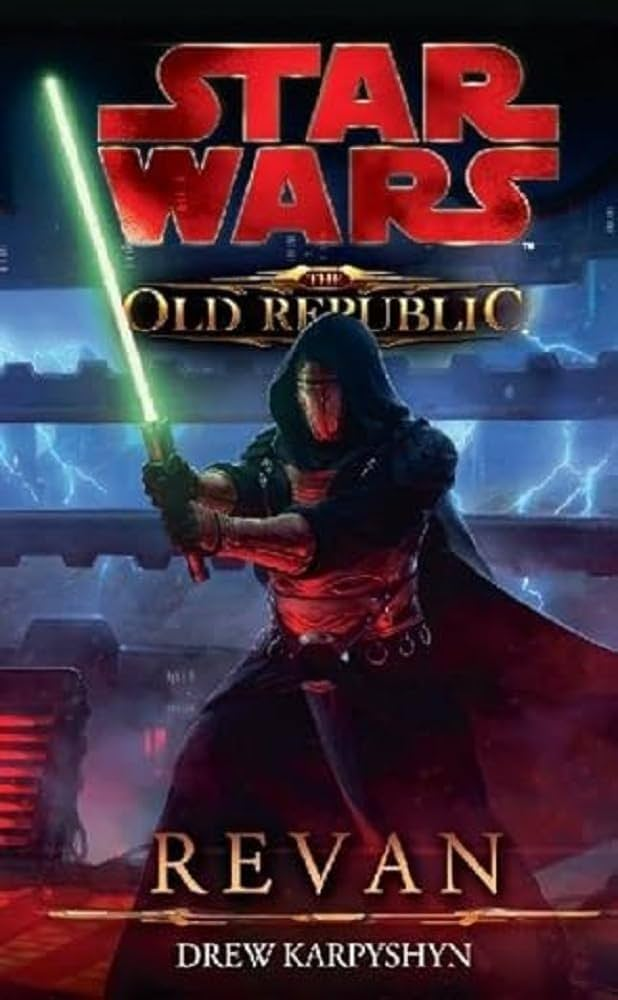
Hello friends! Welcome to book #2 in my Legends Reading Challenge: Revan, by Drew Karpyshyn, published in 2012. It’s been out for quite a while, so there are SPOILERS ahead!!! (And it’s kind of long, lol). By the way, I’m getting the chronological order of the books from a list on Youtini.com.
So Revan is a character from the Knights of the Old Republic video game, and the events of this book occur between in the middle of Revan’s video game story arc. As I’ve said here before, I’m not a gamer, so I felt I had to do some research before I began this book. Youtube to the rescue!
This is what I gathered from my “Revan’s Story” research (very basically): Revan was a very gifted Jedi, strong in the Force, who did not agree with the Jedi Council’s stance on staying out of the Mandalorian conquest of the Outer Rim worlds. He gathered some loyal Jedi who followed him to fight the Mandalorians, including his close friend Malak. At one point during the war, Revan found a Mandalorian mask and put it on, vowing to never take it off until the Mandalorians were defeated. After besting Mandalore the Ultimate in one-on-one combat, the Mandalore revealed that it was a Sith who pushed them to go to war with the Republic, so Revan and Malak went in search of this Sith on the planet Dromund Kaas. It was the Sith Emperor Vitiate, who, when Revan and Malak confronted him, twisted their will to the dark side and sent them out to make war against the Republic.
Now Darth Revan and Darth Malak, they did just that; the Jedi Council decided they had no choice but to fight back and sent Jedi Knights to oppose them, led by Bastila Shan. At this point, Malak had challenged Revan (as Sith do) but Revan won the battle by shearing off Malak’s jaw (oof). Anyway, Bastila confronts Revan, but there’s an explosion and he’s injured. She instinctively tries to save Revan, bringing him back to the Council. They decide to wipe his memory and retrain him as a Jedi. He and Bastila then go back out to defeat Malak, and the two Jedi fall in love, though they both try to ignore their feelings. Malak manages to capture Bastila and turn her to the dark side. After much trial and tribulation, Revan defeats Malak, turns Bastila back to the light, they declare their love for one another and go back to Coruscant to live together. This is a very trimmed down synopsis, and I may have gotten some things mixed up, lol. But it was enough background for me to know in order to start the book, which begins with Revan and Bastila on Coruscant.
Revan unmasked.
Revan is having vivid dreams and nightmares, mostly about a dark, lightning-filled world. He believes it’s some of his memories coming back and is convinced that there’s still something out there that threatens the Republic. We know that it’s the Sith Emperor Vitiate on Dromund Kaas, but Revan has no idea what these dreams mean, only that he is compelled to do something about it.
He decides to talk to his old Mandalorian friend Canderous Ordo. He and Canderous were enemies during the Mandalorian Wars; when the Mandalorians were defeated and the clans scattered, Canderous became a mercenary. Revan meets him during this time, and they work together during the Jedi Civil War to defeat Malak. Anyway, he asks Canderous for help, seeking any information on what he, Revan, had said or done when Canderous knew him. Canderous asks around among his Mandalorian contacts and finds out the clans have been searching for Mandalore the Ultimate’s mask in order to reunite and possibly move against the Republic. Revan had told him he had taken Mandalore’s mask and he and Malak had hidden it somewhere to prevent the clans from reuniting. It was after that he and Malak went to the Unknown Regions and came back as Darth Revan and Dark Malak.
Darth Revan and Darth Malak
Revan believes that finding Mandalore’s mask might help him discover why they went to the Unknown Regions and what happened there. Canderous says that the Mandalorian clans are looking for the mask on the planet Rekkiad. Revan decides he needs to go and find out what his dark dreams mean. When he tells Bastila, she gives him her own news: she’s pregnant with his child. She understandably must stay on Coruscant, and neither of them know if they’ll ever see each other again (spoiler: they don’t). Even so, Revan leaves with Canderous and his loyal droid, T3-M4.
Meanwhile, on Dromund Kaas, we meet Lord Scourge, a Dark Lord of the Sith who arrives to serve Darth Nyriss, a member of the Dark Council. Scourge, like Nyriss and many on the Dark Council, are of the Sith species, red-skinned and strong with the dark side. Scourge is ambitious, as all Sith Lords are, and hopes his service with Nyriss will one day lead him closer to the Dark Council. However, he becomes enmeshed in the entangled machinations of Nyriss, who tests Scourge’s abilities, loyalty, and motivations. It turns out that Nyriss and others on the Council believe the Emperor is mad and will bring the galaxy to eventual annihilation. To convince Scourge of this and recruit his help, she tells the history of Vitiate and what he’s done. He’s lived for over one thousand years; his immortality stems from what he did to his home world, Nathema–through a Sith ritual, he drained the entire planet of life and Force energy, every living being and plant reduced to dead ash (this reminds me of the Blight in the High Republic novels–a deadness that spreads across planets, in which the Force itself is absent). Nyriss decides to take Scourge to Nathema so he can experience it himself and convince him the Emperor must be stopped.
Meanwhile, Revan and Canderous meet up with the Ordo clan on Rekkiad (who are led by Canderous’ wife, Leera). Revan and Canderous find the mask at the top of an ice tower, but Leera has figured out that he’s their old enemy Revan and turns on them. Leera and her team are killed, and Revan gives the mask to Canderous to lead the Mandalorians as Mandalore the Preserver. But seeing the mask unlocks some more memories of Revan’s, which also leads him to Nathema.
Lord Scourge
Scourge, after being on Nathema for a short time and experiencing the total loss of the Force, agrees that the Emperor is mad and must be stopped. He and Nyriss leave the planet, but before they leave the system they detect Revan entering it and crash-landing on the planet. They take him prisoner, leaving T3 behind.
Revan is their prisoner for three years. They get all the information they can out of him, but don’t really have a use for him. What’s interesting is that Scourge becomes interested in Revan. Revan is drugged most of the time to keep his Force abilities at bay, but Scourge will often visit him to have conversations with the Jedi. He knows Revan has mastered both the Light and Dark sides of the Force, which fascinates him. He wants to know about Force visions, which Revan has had (and which darksiders rarely have, apparently). Revan makes use of Scourge’s interest, attempting to plant the idea of Scourge freeing Revan so they can work together to take down the Emperor, a common goal for both of them. Scourge is getting impatient with Nyriss and the rest of the Dark Council, who clearly aren’t going to make a move against the Emperor out of an abundance of caution and fear.
In the meantime, T3 has gotten himself off of Nathema and found Meetra, a Jedi known as the Exile. She’s got a whole backstory of her own (which I learned about on Youtube, but won’t get into here), but basically, she worked with Revan during the Mandalorian Wars and now wants to find him. Meetra goes to Bastila with T3; Bastila gives Meetra two things: a holovid of herself and Vaner–her and Revan’s 3-year-old son–and Revan’s old Mandalorian mask.
Meetra and T3 go to Nathema, where T3 extracts information from the dead city about Dromund Kaas, where they head next. Meetra eventually meets up with Scourge, and they come up with a plan to free Revan so they can work together to defeat the Emperor. Of course, things go terribly wrong.
Scourge, who has had an actual Force vision of seeing Meetra and Revan dead at the Emperor’s feet, starts to have doubts. Unlike the Jedi, he’s unwilling to sacrifice himself for the cause (although he’s willing to sacrifice others). When the battle with the Emperor goes badly, he makes his decision and betrays the Jedi, killing Meetra and showing Vitiate he’s willing to kill Revan. He tells himself he will continue to undermine the Emperor and take him out when the time is right, so their deaths are acceptable. He lies to the Emperor to save his own skin.
Meetra’s Force ghost.
However, the Emperor has another use for Revan–he keeps him in stasis indefinitely, feeding off of his lifeforce. During this time, the Force ghost of Meetra stays by his side, giving him strength.
Scourge is rewarded by Vitiate with immortality and the title of “Emperor’s Wrath.” The ritual to achieve this is extremely painful, and to Scourge’s dismay, he finds out after the ritual that the pain never ends. He’ll just eventually “accept” it and become numb to any emotions, which runs counter to his plans–as a Sith Lord, he counts on his anger and hate, as well as that of his enemies, to fuel his power, a power he had hoped would increase over time so he could defeat the Emperor. Ah well, make a deal with the devil, and you get what you deserve.
The epilogue shows Bastila, an old woman fifty years later, talking with her son and grandchildren. Vaner has not inherited force-sensitivity and got into politics instead, helping to rebuild the hurting Republic. Bastila misses Revan, but believes he achieved his mission, as there has been no threat to the Republic since he left.
It’s very sad, and I’m glad she doesn’t know the truth–that Revan is alive and being held by Vitiate and will be for the next TWO HUNDRED FIFTY YEARS. Revan’s story isn’t over, and I assume the next game tells it–that eventually Revan is freed from his prison and splits into two beings: the “good” Jedi part that becomes a Force ghost (I think?) and a living being that is all dark-side revenge against the Emperor. Say what you want about Legends, it’s over-the-top nuts! But in a fun way, lol.
Despite not having played the game, I enjoyed this book. I liked Revan and his story, but he’s kind of larger-than-life, which makes sense–he’s a mythical figure to the Jedi. Surprisingly, I found Scourge to be the most interesting character. He’s bad, no doubt about it, but he’s complex, too. Ambitious, brutal, but understands the existential threat of Vitiate and willing to work with the Jedi to defeat him. But only to a point. Sith like absolutes–Scourge wants to know that they will definitely win if they go up against the Emperor. Revan tells him they must have faith in the Force and do their best–and be willing to sacrifice their lives for it. This doesn’t satisfy Scourge, lol. The Force vision he has (which he thought he wanted) doesn’t help. He doesn’t know how to interpret it, and it makes him skittish. That doubt seals his fate–once the battle goes downhill, he decides to save himself, rationalizing that at least one of them will live to continue the battle. But he only gets eternal pain as a result, which–duh, dark side.
Rating: 4 out of 5 lightsabers.
Anway, a cool book, and I’m really starting to get into this Old Republic stuff. Onward to Darth Malgus in The Old Republic: Deceived.
Hello friends, and welcome to the first post of my Legends Reading Challenge. The first book in timeline Order is Dawn of the Jedi: Into the Void, by Tim Lebbon. It was published in May of 2013, and ties into a collection of comics called Dawn of the Jedi. (I’m only reading the adult novels, and not any comics or junior novels, etc).
Into the Void takes place about 25,000 years BBY (Before the Battle of Yavin). It has date references such as 3,500 TYA, 7,537 TYA, 10,661 TYA, etc., with chapters starting with a quote from some Master. TYA stand for “Tho Yor Arrival,” which refers to eight ships that arrived in the Tython system long ago, from a mysterious, far away system, and which held Force-sensitive beings. They began the settlement on Tython and eventually became the Jed’aii Order. These ancient Jedi strove to find a balance between Ashla (the Light) and Bogan (the Dark).
I had to look up a few of these things on Wookieepedia, as I didn’t know much about this time period and the book doesn’t exactly spell it out. I have a feeling the comics delved much deeper into the ancient lore. This book tells the story of a particular Jed’aii, Lanoree Brock, that lived about 10,000 years after the Tho Yor appeared. She is a Ranger, akin to a Jedi Knight’s role and responsibilities, travelling the system and helping out in whatever way she can. There is no hyperspace travel at this point, so they’re contained to the Tython system.
Lanoree is called back to Tython to speak with the Jed’aii Council concerning a new mission. They’re concerned about a cult called the Stargazers, who have developed a device that, if detonated near a supposed “hypergate,” will either cause a hyperspace gateway to open up, or cause a black hole that will swallow the entire system. They want Lanoree to find this group and stop them. The twist is that the leader of this group is Dalien Brock, Lanoree’s brother, who has long been thought dead.
The book flips back and forth between the present and the past; it tells of Lanoree and Dal’s relationship and childhood. Their parents are both Jed’aii, and Lanoree has a strong connection to the Force. Everyone expects Dal to have that connection as well, but…he doesn’t. This seems to be something they can’t accept, as they believe he’ll eventually “allow the Force in,” as if he’s actively pushing it away. This kind of confused me–is he Force-sensitive or not? Because if you’re Force-sensitive, why would you actively reject it? Dal seems to hate the Force and everything about it, but I assume it’s because he can’t access it. His parents and sibling don’t seem to accept this and keep encouraging him to continue with his studies. He and Lanoree travel across Tython on their “Great Journey” to different temples where they study different aspects of the Force. Each time, Dal fails miserably. Is it any wonder he becomes bitter and hateful? They keep expecting him to do this thing he cannot do.
Anyway, Dal becomes obsessed with the ancient myth of their ancestors, who they were and where they came from, and is determined to somehow get back there. He finally murders a Jed’aii student and flees to the Old City, which is a ruin built by an ancient race, the Gree. Not much is known about them, but Dal believes there is a hypergate deep in the bowels of the City. Lanoree follows him, hears him scream, and finds his bloodied clothing. Everyone assumes he’s dead.
In the present, it seems her brother is definitely not dead, and Lanoree is instructed to find him and stop him–kill him, if she must. With the help of a Twi’lek Jed’aii contact named Tre Sana, she follows a trail from Khalimar to Nox to Sunspot, playing a game of cat and mouse with Dal, who she believes has gone completely mad. Twice he tries to kill her, and twice she survives. She finally catches up to him back on Tython as he brings his device to the Old City and very nearly initiates the device before Lanoree kills him.
An artist rendering (Albert Umanov) of Greenwood Station on the planet Nox.
It took me a bit to get into the book, but once it got going, it was fine. I found the Jed’aii Order interesting, especially the temples the young learners had to visit on their “Great Journey” to finish their training. Tython itself is described as a planet strong in the Force, and it seems only Force-sensitives can manage to live on the planet. Their code wasn’t as solidified as we see in the later Jedi; these Jed’aii strive for balance between the Light and the Dark. I can see where some fans got the idea for the “Gray Jedi” in this story.
Lanoree herself, though she doesn’t relish killing, separates quite a few heads from bodies in this story, if it serves her mission (with a metal sword; there were no lightsabers yet). She also studied and had a proficiency in Alchemy, a “manipulation of the flesh through use of the Force,” which I thought very weird, to say the least, lol. She conducted experiments on her ship, the Peacemaker, in which she grew living tissue from her own cells, and which she used to heal herself when Dal shot her in the chest at point-blank range. She was always trying to balance the influence of Bogan (the Dark) when she felt pride and power from her accomplishments. She was also tempted to try Dal’s device herself after he was dead, to see what would happen. Just for a minute.
This was a fairly entertaining book, and I learned a lot of Legends Lore about the early incarnation of the Jedi, a good start to my Legends Reading Challenge.
Hello friends! May was a busy Star Wars month, so let’s get right to it. 🙂
TheBad Batch series finale. Although this is the first thing listed, it’s the last thing I wrote because I don’t even know where to begin with this, lol, and summing it up in a few paragraphs is impossible. I’ve been very emotionally involved in this series since it began, and having it come to an end has been bittersweet. I’m not going to go into details of the show here (I’m assuming you’ve watched), just feel all my feelings, lol.
First off, I feel that Season 3 has been pretty solid, particularly Crosshair’s character arc and redemption. There are lots of characters I would have liked to see return or at least know what happened to them (Cody? Cid? Wolfe? More Rex and the clones? I definitely would have liked more Phee, too) but the season focuses on the Batch and their mission, as it should.
The whole “Is Tech still alive?” thing was really up in the air for me; at the beginning of the season I thought there might be a possibility, and there seemed to be some clues planted here and there. But by the last few episodes I concluded he was truly gone and subsequently had to grieve for him all over again, but also feel relieved that he didn’t come back as some awful brainwashed assassin like the CX’s, Winter Soldier-style, which is the only way I feel he could have come back. But now I can at least move on and know that his sacrifice allowed the happy ending for his family that we got. (There’s always my alternate-universe fan-fiction, where he does survive, and I can live there simultaneously with the canon version, lol).
Anyway, there were so many doom-sayers that were convinced that everybody was going to die at the end in Rogue One style and I just wanted to say to them: um, shutup? I suppose it was one possibility, but I really didn’t think the series would go that route. At most, I thought we’d lose maybe one more member, but I think Tech was enough to make the point that not everyone gets out alive and that there are stakes. The fact that they all survived and got to live out their lives on Pabu pretty much made me over-the-moon happy (At least this part of my fan-fiction was validated! As well as Omega eventually going off to fight in the Rebellion). Even Emerie survived, who I thought for sure would sacrifice herself to help the children escape. I’m glad she lived, too.
Like I said, there’s so much I could touch on here but I’ll just say that I loved every minute of this last season and the finale was everything I hoped for. The tears didn’t start until the credits rolled, because it was then I knew it was over, and that made me sad; but the Batch were allowed to get old on beautiful Pabu and be whatever they wanted to be, and that made me happy. I like to think that they not only helped Rex find the kids’ parents, but also helped out with the Hidden Path in some way, helping Force sensitives evade the Empire. Not fighting anymore, just doing their little part, helping where they could. A good life with purpose.
I’m hoping to see Rex, Echo, Emerie and the other clones in some future project, as well as Omega during her Rebellion adventures. I dream of her and Hera reuniting and giving the Empire hell! And maybe a cameo by the Batch in any of these stories. A girl can dream, lol.
Tales of the Empire. So this show was part of the May 4th festivities, and I couldn’t wait to watch it. I really liked it, for the most part. I think I like Tales of the Jedi better, but this one gave us some insight into Morgan Elsbeth and the long-awaited return of Barriss Offee. Out of the two characters, I preferred the Barriss episodes. The theme of the shorts was how these two different characters reacted to the rising dark, and how they dealt with the idea of revenge.
Morgan was a young Nightsister on Dathomir when her people were slaughtered by the Separatists, led by General Grievous. She survived, but instead of joining the Mountain clan (which seems to be guided by the Light side of the Force, while the Nightsisters draw from the Dark side), she decides to strike out on her own and seek revenge. At first, I wasn’t sure who she was going to wreak vengeance upon, since the Separatists are no more. But I see now that she’s playing the long game, using the Empire (and Thrawn) to consolidate her own power for Dathomir (as she says in Ahsoka, “For Dathomir” under her breath in response to Thrawn’s “For the Empire.”) Unfortunately, that means hurting others in her quest for power.
Barriss, after Order 66, is offered the opportunity to become an Inquisitor, which is what a lot of us theorized. Even though I did like her shorts better, there’s always been something about Barriss that just didn’t make sense to me. She’d been disillusioned with the Jedi and thought they were becoming more war-like, losing their way, so she…rigged an explosion in the Jedi temple? And framed her “best friend” Ahsoka for it? It didn’t quite make sense, especially since she seemed to be an excellent Padawan in every other way. But okay.
Now, after Order 66, she’s given the opportunity to become an Inquisitor, considering her aforementioned crimes. But every step of the way, she resists the darkness. She kills the other Padawan to survive, not because of any inner ambition. She repeatedly questions their orders and missions and seems naive about their true aims. She doesn’t seem brutal enough to have passed their tests in the first place (having read Rise of the Red Blade, yes, they are terribly brutal, culling any sign of weakness whatsoever.)
Anyway, Barriss decides the Inquisitorious is not for her and saves a Jedi she and the Fourth Sister are supposed to kill (I do like that we get more of her, since she didn’t have much to do in the Obi-Wan series). She goes off and becomes a “Wise Mother,” using her Force healing skills to help others. There’s some evidence she’s a link in the Hidden Path, helping Force-sensitives get away from the Empire. I like this destiny for her; she may have believed the Jedi Order didn’t work, but neither did she think going to the dark side would help anything, either. She just uses her gifts to help others.
I do feel like the Fourth Sister came back to the Light much too quickly, but maybe she was already halfway there after years and years of anger and hate. Honestly, I don’t know how anyone can sustain themselves on those exhausting emotions for so long. She accidentally impales Barriss in the cavern in trying to get out; but we don’t know if she actually died or not. So now we’ll continue to get more questions of “What happened to Barriss?” LOL.
The Acolyte excitement and trailers. I just want to point out that in two weeks, The Acolyte premieres and I’m sooo ready for it! The trailers have been awesome and I can’t wait to sink into this Jedi murder-mystery thriller at the end of the High Republic. Naturally I’ll be talking about it more next month.
The Phantom Menace in the theater. For May the 4th weekend, I caught The Phantom Menace in my local theater. It’s celebrating 25 years since its premiere, which is a little crazy to me, lol. When it first came out, I brought my 8-year-old stepson, who loved Qui Gon Jinn, and Maul’s double-lightsaber. At the time, I wasn’t quite so open-minded as I am now and just didn’t get it. It wasn’t “my” Star Wars. It was so different from the OT that I couldn’t really embrace it at the time. But I did it for the boy, lol. And subsequently brought him to see Attack of the Clones and Revenge of the Sith, when they came out.
Now that boy is thirty-three and brings his own young son to see all the Star Wars (and Marvel) movies. And me? I love them, of course. I’ve since relaxed A LOT and just enjoy them for what they are–fun Star Wars movies. Back then, Jar Jar grated on my nerves, and I thought he was a stupid character; now I just want to give the big goof a hug. Obi-Wan Kenobi as played by Ewan McGregor has become one of my all-time favorite Star Wars characters. Qui Gon is also a favorite Jedi character; they’re all quite interesting, but I think they’ve been improved upon in subsequent material like The Clone Wars, and many other projects like the Obi-Wan Kenobi and Ahsoka series, never mind countless books.
So it was a fun ride watching the film on the big screen again, this time with a lot more appreciation.
In books, I was kind of all over the place this past month. While waiting for the next High Republic book to come out (Temptation of the Force on June 11th), I went back and forth with a few different things, not really sure what I was in the mood for. Here’s a few books I started but haven’t finished yet (and may or may not finish):
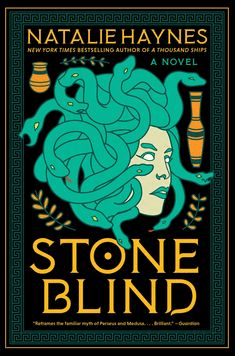
Stone Blind, by Natalie Haynes. I’m often drawn to retellings of ancient mythical stories, especially since modern retellings will often turn them on their heads with different perspectives and interpretations. The Medusa myth has always fascinated me: the story of a goddess who was turned into a monster, and whose gaze turned men to stone. Naturally, when I found out some time ago about the details of the story–that Medusa had been raped by Poseidon, was blamed for the incident and turned into the monster–I felt outrage. Typical “blame the victim” patriarchy, misogyny at its worst; good for her, turning arrogant men who would hunt her into stone, they deserve it, and what have you. Yet I wanted to see what this version would bring to the story.
But I wasn’t too far in when I realized why I haven’t read Greek myth retellings for a while now: the rapes kept adding up, and so did my rage. They weren’t particularly graphic scenes; just the fact that they happened on the regular, by Zeus in particular (what a vile creature he is), just made me sick. In fact, all of the Olympian gods are vile and arrogant and petulant and just plain odious. I suppose that’s the point. But I just couldn’t get through it.
I suspect I’ve been spoiled, in a way, by Star Wars books (and movies and shows). Gender oppression isn’t a thing in these stories, not by a long shot. It doesn’t exist. Rape is never, ever mentioned (this is a PG-rated world, after all), but more than that, in the world itself, women (or transgender persons, for that matter) are simply taken for what they are without question. Good, bad, meek, strong, beautiful, ugly, rulers, peasants, soldiers, parents; gender doesn’t play into the role at all (neither does ethnicity nor sexual orientation). Certainly, there are those in our world who have something to say about this and Star Wars “wokeness;” but I have no patience for any of their nonsense and ridiculous labels.
Anyway, what I’m saying is, I’ve read so much Star Wars and immersed myself in this world so much, that when I encounter misogyny and other bigotry in other books, it’s jarring and upsetting to me. As it should be, but…mental health, lol. So Stone Blind has been set aside for now.
Canto Bight, by various authors. So I retreated into another Star Wars book, one that I haven’t had much interest in but thought I’d finally check out since there didn’t seem to be much else I wanted to read. But…it’s boring, lol. The first story was a bit amusing, but I don’t know or care about these characters at all. And Canto Bight isn’t a setting I’m particularly fascinated by. Set aside for another time, perhaps.
Medstar 1: Battle Surgeons, by Michael Reaves and Steve Perry. So now that I’ve watched Tales of the Empire, I’ve got Barriss Offee on my mind, lol, and want to know more about her besides what we see in the Clone Wars. She’s in a couple of Legends books called Medstar: Book One: Battle Surgeons and Book Two: Jedi Healer. They’re like a Star Wars M*A*S*H, following a group of doctors and nurses on the planet Drongar that sew up and treat clones that are injured in battle. The battle is being waged here for a special substance called bota that’s kind of like bacta, and both sides want it. There’s an arrogant Tera Kasi warrior, an ambitious Republic Admiral, and an unidentified spy in their midst. I like how Barriss is portrayed as a Force healer in these books, as we see in the last short of Tales of the Empire. We don’t see too much of that in canon until Rey in the Sequel Trilogy. I just started the first book, and already I like it better than the other books I’ve tried to read lately. I’ll write more about them next month.
That’s it for this month (that’s plenty!). How did you celebrate May the Fourth? What’s been entertaining you? Let me know in the comments and we’ll talk about it!
I can’t believe I’m just finding out that Bail’s full name is Bail Prestor Organa. Proving the fact that I learn something new about Star Wars every single day, which is pretty awesome.
Anyway, at first I thought I’d do a Bail appreciation post, since it seems to me that fans have a soft spot for this most excellent space dad (myself included); then I thought, nah, I’ll do another fan art post. I ended up just mixing it together, and voila! Fan art and a lot of appreciation for this character who pops up in many places–movies, comics, and a lot of books.
As I scrolled around looking for great images of Bail, I came across a couple that illustrated a few scenes from Legends, and so I included those too. Enjoy!
Senator Organa in his finery.
simon950 on deviantart.com
I love this one of Bail and Leia in his office on Alderaan. I’m not sure if it’s illustrating a particular scene from anywhere, but I love that he’s comforting her in his wonderful Dad way.
starwars.wikia.com
Again, I’m not sure if this one is illustrating a particular event, but it looks like Bail with Mon Mothma, Admiral Ackbar, and some other unnamed gentleman (arms dealer?). They seem to be looking over an X-Wing, possibly for sale for use in their nascent Rebellion.
This one of Bail and Breha’s last moments on Alderaan just guts me. They worked so hard and tirelessly to oppose the Empire, and they paid for it with their lives (and the lives of all those on Alderaan). Right in the feels.
starwars.wikia.com
This one of Bail carrying Obi-Wan Kenobi just begged the question: what the heck is going on here? Captioned “Mission to Zigoola,” I looked it up and it’s a scene from the Legends book Clone Wars: Wild Space, by Karen Miller. Bail and Obi-Wan on a mission together? I must have this book. And so I immediately ordered it on Amazon, lol. I will read it after my current book and let you know exactly what is going on here.
Mission to Zigoola, Chris Trevas on twitter.com
This isn’t a scene from a particular book (I don’t think), but it does illustrate Leia saying goodbye to Bail as she heads to Toprawa. In Legends, Toprawa is the planet (or system) from which Leia receives the Death Star plans (obviously before Rogue One came out). It’s the last time she sees him alive.
Mission to Toprawa (i.pinimg.com)
There’s something about Bail that is just so endearing–he’s kind, reliable, a great father to Leia, a loving husband, a Senator and a Viceroy to Alderaan, he helped the Jedi when they desperately needed it, and he was a key player in forming the Rebellion early on. I can’t find a single flaw in the man. That’s nice to see once in a while, especially in Star Wars when a lot of the characters have character flaws that lead to trouble, lol. Bail’s a rock in the violent sea, a polestar in the heavens.
What’s your opinion of Bail Preston Organa? What do you think of these images? Let me know in the comments and we’ll talk about it!
I’m just starting to learn a bit about Legends material in the Star Wars universe. I’ve read a few Legends books (reviewed on my sister blog The Star Wars Reader), but whatever I’ve learned there, it’s just the tip of the iceberg. There is literally decades’ worth of material, in hundreds of novels, comics, games, and other media. This may seem daunting, and it is to a certain degree, but it’s also exciting to me. I’ve got tons of material to keep me busy for years; years of learning something new about Star Wars. Can it get any better than that? I think not.
Anyway, even though Rebels is considered canon, it’s introduced me to the concept of the Jedi Temple Guards, which already existed in Legends as a particular kind of Sentinel. When Kanan confronted the Guard in the Jedi Temple on Lothal, I was instantly fascinated. I do believe there were some Temple Guards in CloneWars as well, escorting Bariss Offee away after she was arrested.
Also, when I did a bit of research on Jedi lightsabers, I learned that certain kinds of Jedi tended to wield certain lightsaber colors. The three major Jedi specialties are Guardian, Consular, and Sentinel, with various subtypes within each. Here’s some basics that I’ve learned:
Guardians
Guardians focused on combat training and were known for their skills with a lightsaber. They are called upon to defend the weak and uphold the laws of the Republic. Their lightsabers were often blue; examples of Jedi Guardians are Obi-Wan Kenobi and Anakin Skywalker.
Subtypes of Guardians include:
Exotic Weapons Specialist. These rare Jedi specialized in weapons other than lightsabers, such as lightsaber pikes, flails, whips, and blasters.
Lightsaber Instructors. These were appointed by the Jedi Battlemaster to instruct Jedi Initiates.
Jedi Ace. These were highly skilled Jedi pilots and dogfighters organized under the Jedi Starfighter Corps.
Jedi Peacekeeper. These were Jedi who specialized in policing the galaxy and ensuring laws were enforced in the Outer Rim. They usually worked alongside local militias and police forces.
Consulars
Jedi Consulars used words or nonviolent use of the Force to settle disputes. They sought mental refinement through study and meditation, and pursued the art of diplomacy and mediation. They hoped to calm tense situations through civil discourse, reasoning, and parley, and only drew their lightsabers (usually green to denote their commitment to peace) as a last resort. Examples of Consulars include Luke Skywalker, Yoda, and Qui Gon Jinn.
Subtypes of Consulars include:
Ambassador. These Jedi were the face of the Republic, acting as liaisons between newly discovered worlds and the Republic.
Diplomat. These Jedi were negotiators who often wrote treaties and resolved political disputes.
Healer. These Jedi drew upon the Living Force to heal wounds and cleanse impurities. (Bariss Offee was studying to be a healer, at least in Legends).
Lorekeeper. The Lorekeepers were divided into historians, archivists, and librarians, and maintained the Jedi archives. (Jocasta Nu, we see you!)
Researcher. Researchers updated the Jedi archives, and were made up of many specialists, including mathematicians, biologists, geologists, archaeologists, etc.
Seers. Jedi highly attuned to the Unifying Force were gifted with pre- and post-cognition. In rare cases, a seer became a prophet, divining things such as the prophecy of The Chosen One.
Sage. A Sage is a Jedi of advanced learning and wisdom, and who specialized in telekinesis and Force healing. They were also expert trackers, who could find people across the galaxy through deep meditation (I see you Luke in VIII and Leia in IX!)
Shadows. Masters of lightsaber combat, Shadows worked silently and alone, wielded double-bladed lightsabers, and could mask their presence with the Force.
Sentinels
The Jedi Sentinels sought a balance between the Guardian and Consular schools of thought. Blending the teachings of both, they also included some non-Force skills such as security, computers, stealth, or medicine. They sought out cities and civilians, rather than staying in the solitude of the Jedi Temple. Their lightsabers were often yellow,gold, or orange. Examples of the Sentinel class are Plo Kloon and Yaddle.
Subtypes of Sentinels include:
Artisan. These Jedi often built lightsabers and holocrons, in their attempt to understand creativity as a central aspect of the will of the Force. They have intrinsic skills with tools and machines. (I better understand now why Rey’s lightsaber is yellow–she’s a kind of Sentinel, an Artisan in particular).
Investigator. Often working as trackers or spies, Investigators worked closely with law enforcement to solve crimes, and often went undercover. Not to be confused with Shadows, who worked to discover Dark Side Adepts.
Recruiter. These Jedi tracked down and identified Force-sensitives, and determined whether or not they belonged in the Jedi Order.
Shadow. The secretive Shadows worked to seek and destroy all traces of the Dark Side of the Force.
Temple Guard. These Jedi were anonymous Sentinels who served as a security force in the Jedi Temple. They wore formal robes and identity-concealing masks, as the ultimate expression of emotional detachment. They carried double-bladed lightsabers. (The Grand Inquisitor in Rebels had been a Temple Guard before Order 66, and that’s who Kanan is facing in the scene above).
Watchmen. These Jedi worked alone and for years on a single planet or system, protecting their rights, overseeing the pursuit of peace, and acting as a liaison between the planetary government and the Jedi High Council.
Who knew the Jedi were so diverse? Not me. Most of these divisions were originally referenced in gaming or comics, and that’s why I’m not too conversant in them. But I do think they’re fascinating and make the Star Wars universe richer for it.
What do you think of all these Jedi specializations? Do you have a favorite? As I’ve mentioned, I love the Temple Guard. Drop me a line and we’ll talk about it!
Thanks goes to Wookiepedia for all this cool information!
Your source for everything Obi-Wan Kenobi. This is the companion blog to the @AllThingsKenobi Twitter. Because our love doesn't always fit into 280 characters.











 Star Wars and Other Obsessions